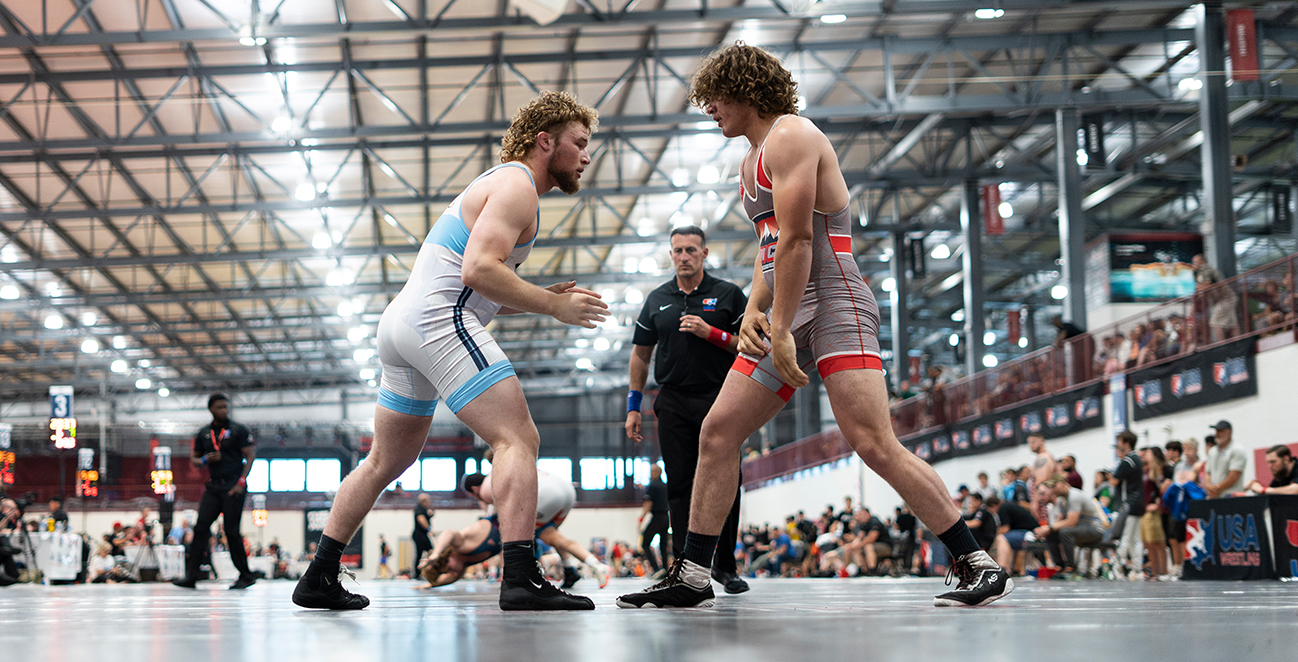
Wrestling College Athletic Scholarships for Men
If you’re a high school wrestler who wants to compete at the college level, you probably already know you’ll face stiff competition for both a spot on the roster and scholarship money. We’re here to help. This webpage is a resource for you to use during your college planning and placement process that will help you get noticed, meet deadlines and achieve your goal.
Never forget, in wrestling—as in all collegiate sports—you need to take charge of your own recruiting. Narrow down the schools you’d like to attend and compete for. Then, take responsibility for introducing yourself to your sport’s decision-makers at these schools. Keep yourself in front of them in a professional, respectful way with regular emails or phone calls. Work hard to improve your athletic performance while also keeping an eye on your academics.
Earning a spot on any college team—and maybe even being awarded athletic scholarship money—isn’t easy, but don’t despair. While it takes time, discipline and persistence, it is doable.
Men’s Collegiate Wrestling—Divisions
As in other college sports, men’s wrestling is organized by division under two primary governing bodies: the NCAA and NAIA. Here’s an overview of how these divisions work.
NCAA Division I
- There are 78 men’s Division I wrestling programs in the U.S, with 9.9 maximum scholarships per team and 10 weight classes. If you dream of being recruited for a DI wrestling team, you’re competing against the best wrestlers in the country for a roster spot. Certain DI conferences routinely send wrestlers to the Olympics. Put all of this together, and coaches and scouts at these schools can be very picky when it comes to recruiting.
- College sports in general are classified as either head count or equivalency. The main difference between the two in the NCAA is how scholarship money is awarded. Head count sports have a set number of full-ride scholarships awarded to individual athletes. Equivalency sports have a set amount of scholarship money that coaches typically divide up.
- Since wrestling is an equivalency sport, the scholarships are usually divided between several student athletes, making it rare for a single student athlete to receive a full-ride scholarship.
Top Division I Wrestling Programs
Next College Student Athlete (NCSA) offers Power Rankings of the country’s best colleges with men’s wrestling programs, and are compiled using a number of data sources that factor in various aspects of the college experience, including cost and graduation rates. Use it as a starting point in your search for a college-level wrestling program you’d like to be accepted into.
Here are the top ten DI men’s wrestling programs in the U.S., according to NCSA:
- Stanford University
- Princeton University
- Harvard University
- Columbia University
- University of Pennsylvania, Penn
- University of Michigan
- University of North Carolina at Chapel Hill
- Duke University
- University of Virginia
- Ohio State University
NCAA Division II
- There are 64 Division II men’s wrestling programs in the U.S. But just because it’s not DI, don’t be fooled. Wrestlers of DI caliber may select a DII school instead for the better balance between the social, academic, and athletic aspects of college a DII wrestling school offers.
- DII schools have a range of student population sizes, and more than half of the schools have less than 3,000 students. Student-athletes who prefer a more involved learning process can better thrive in these types of institutions, compared to the huge lecture halls filled with hundreds of students that are staples of DI schools.
- A fully funded DII team can offer up to nine scholarships. As mentioned, coaches frequently divide their scholarships between various student-athletes as they deem fit.
Top Division II Wrestling Programs
NCSA offers Power Rankings of the country’s best colleges with men’s wrestling programs, and are compiled using a number of data sources that factor in various aspects of the college experience, including cost and graduation rates. Use it as a starting point in your search for a college-level wrestling program you’d like to be accepted into.
Here are the top ten DII men’s wrestling programs in the U.S., according to NCSA:
- Colorado School of Mines
- Maryville University
- University of Indianapolis
- Gannon University
- San Francisco State University
- Mercyhurst University
- Augustana University, South Dakota
- Ashland University
- University of Findlay
- Seton Hill University
NCAA Division III
- There are 109 Division III wrestling colleges. That’s more than at any other level. Wrestlers who want to push themselves academically as well as athletically may find the best fit at a DIII school—able to develop as athletes while still having time and flexibility in their schedules to pursue passions and interests outside of wrestling.
- Notably, DIII schools don’t offer athletic scholarships. However, academic-related grants can, and often are, used in lieu of athletic scholarships. Since many DIII wrestlers receive financial aid, seeking a DIII roster spot is often a good way to offset the overall cost of college.
Top Division III Wrestling Programs
NCSA offers Power Rankings of the country’s best colleges with men’s wrestling programs, and are compiled using a number of data sources that factor in various aspects of the college experience, including cost and graduation rates. Use it as a starting point in your search for a college-level wrestling program you’d like to be accepted into.
Here are the top ten DIII men’s wrestling programs in the U.S., according to NCSA:
- Johns Hopkins University
- University of Chicago
- Williams College
- New York University
- Washington & Lee University
- Case Western Reserve University
- Wesleyan University
- Trinity College, Connecticut
- Wheaton College, Illinois
- Gettysburg College
NAIA
- The National Association of Intercollegiate Athletics (NAIA) can give student-athletes a more well-rounded college experience than even DIII schools. There are 68 NAIA schools that offer men’s wrestling. Fully funded teams can offer up to eight scholarships, which are divided up depending on the team’s needs for certain weight classes and how the coach chooses to allocate money throughout the team. The average roster size is around 30 student-athletes.
Top NAIA Wrestling Programs
NCSA offers Power Rankings of the country’s best colleges with men’s wrestling programs, and are compiled using a number of data sources that factor in various aspects of the college experience, including cost and graduation rates. Use it as a starting point in your search for a college-level wrestling program you’d like to be accepted into.
Here are the top ten NAIA men’s wrestling programs in the U.S., according to NCSA:
- Oklahoma City University
- Marian University, Indiana
- Southeastern University
- Northwestern College, Iowa
- St. Ambrose University
- Vanguard University
- Concordia University, Nebraska
- Baker University
- Grand View University
- University of the Cumberlands
What Does It Take to Become A Collegiate Wrestler?
For starters, it doesn’t hurt if you have great technical ability, but there are other ways to get the attention of a coach. As an example, how do you respond to adversity? How do you manage stress or pressure? Remember, recruiters are looking at the big picture, the total athlete.
Getting recruited also takes name recognition. In almost all instances, you need to let coaches know you’re interested in getting into their wrestling programs. Here’s how to do that:
- Build A Target List
Don’t waste time pursuing programs that aren’t a good match. Look at the roster to see how you qualify athletically and learn more about the school’s academic requirements.
- Create An Online Profile
Think like an influencer, i.e., you need a platform to get noticed. Make it easy for coaches to see your highlight video, key stats, contact information and academic history.
- Make Contact, Follow Up
You can’t sit around and wait to be discovered. Proactively reach out to college coaches by sending an introductory email that includes your online profile, highlight video, academic information, outstanding athletic achievements and personal interest in the program. Then continue to follow up with noteworthy updates throughout the year.
- Get Visibility
Tournaments are an opportunity to test your skills against top talent and compete in front of college coaches. If you time it right and contact these coaches before you attend a tournament or camp, you’ll improve your odds of being evaluated in-person.
- Be Persistent
If you’re an upperclassman who isn’t being actively recruited, rework your target list. Consider new opportunities, including lower-division programs where you might be more competitive. Make visits. Tap your high school coach for help in identifying programs.
You may have talent and self-discipline, but unless you get your name out there in a consistent and respectful way, you may also fly under your preferred program’s radar. Show those coaches and scouts how much you want to compete for them in their wrestling program. That type of drive gets attention and will help you distinguish yourself from those you’re competing with.
Weight Classes In College Wrestling
- For men, there are 10 college wrestling weight classes established by the NCAA: 125, 133, 141, 149, 157, 165, 174, 184, 197 and heavyweight (183 to 285). Once the NCAA determines a wrestler’s weight class, he can’t compete below it and can only compete one level above it.
- To predict a student-athlete’s collegiate weight class, coaches look at how the recruit has competed over the course of a few years. For example, if a high school wrestler started at 106 his freshman year, then competed at 113 his sophomore year, and netted out at 120 his senior year, the coach will note this athlete’s gradual growth and most likely recruit him for 125.
- Even so, many college wrestlers continue to develop and get stronger after high school, which is why redshirting is more common in wrestling than other sports. Redshirting means athletes can’t compete for one academic year, but they can still participate in practice. By doing so, they gain a fifth year of eligibility. This is a good solution for some college wrestlers preparing to jump weight classes, or for freshmen who are still adapting to collegiate competition.
- But the easiest way to determine a coach’s recruiting needs is by looking at the roster. How many wrestlers are in your desired college wrestling weight class? Are they upperclassmen who are getting ready to graduate? Taking time to study a team’s roster can provide insight into a coach’s recruiting strategy and help you gain a competitive edge.
When Can Colleges Start Recruiting for Men’s Wrestling?
- The NCAA dictates when and how college coaches can contact recruits. For NCAA DI and DII coaches, contact is off-limits until June 15 after the recruit’s sophomore year in high school. College coaches at the DIII and NAIA levels don’t have the same restrictions on when they can reach out to recruits, i.e., they can reach out to anyone they’re interested in at any time.
- On August 1 before junior year, NCAA wrestling recruiting rules permit student-athletes and their families to make an “official visit.” This means that recruiting efforts really ramp up during junior year. Coaches can send non-recruiting material, like brochures or camp information, at any time. This is also the same time that college coaches can begin communicating with high school and club coaches about student-athletes.
- In creating these rules, the NCAA was trying to make sure elite recruits didn’t get overwhelmed by contact from coaches. However, coaches begin building their potential list of recruits far earlier. That’s why the more proactive you are in your recruiting journey—by targeting schools, creating a highlight video, emailing coaches, etc.—the better your chances are of getting recruited.
Wrestling Recruiting Guidelines by Division Level
| Tier 1 |
Tier 2 |
Tier 3 |
Tier 4 |
| Division 1 |
High Division II, III, and NAIA |
Division II, III, and NAIA |
Low NAIA and Junior College |
| Multiple-time state champion and national tournament placement.
High national ranking on sites like FloWrestling or InterMat Wrestling.
Top 1-5% of high school wrestlers are recruited by DI schools. |
DII: High state placement.
Nationally ranked on sites like FloWrestling or InterMat Wrestling.
DIII and NAIA: State tournament experience.
Winning regional and district titles. |
Three years varsity experience. High district and regional placements.
Off-season wrestling is encouraged. |
At least two years varsity experience. |
| Wrestles off-season at a competitive club. Attends FS/GR national events, Super 32 and NHSCA Nationals.
Achieves high placement(s) at those events. |
Belongs to off-season club program. Attends state championship events and achieves successful results.
Attends national level events. |
Pre-season club wrestling is a plus. Attends camps to gain exposure with college programs. |
Attends camps and clinics. Isn’t a member of an off-season club due to multiple sport obligations. |
Final Thoughts on Achieving Your Goal
As mentioned earlier, while earning a spot on any college team isn’t easy, with time, discipline and persistence it is doable. Here are some final words of wisdom and strategy on the matter.
- Find The Right Match
By researching schools and targeting programs where your particular skills would add to the team’s ability to put up points, you have a better chance of not just landing a spot on a college roster but even getting some scholarship money. So do your homework and find a program that will benefit from your event strengths. It’s a good way to make yourself stand out to a recruiter.
- Create A Target List
It’s worth repeating. After you’ve done your research, create a list of schools you’re competitive for. There might be a range of programs that span several different levels. As an example, your event times may put you in the mix for DI recruiting, but if you consider DII or NAIA, as well, you might have a better chance of earning a roster spot. Putting it all done on paper (or in a digital document) will help you order your thoughts and see the overall situation more clearly.
- Keep Up Your Grades
Speaking of homework, make sure you keep a focus on your academics as you strive for excellence in your sport. Recruiters will be looking at both. Make sure you’re taking classes as required by the NCAA Eligibility Center, as well as the ACTs and SATs. And if you do land a spot on a college team, you’re going to be expected to keep up your academic performance along with your athletic performance, so you might as well get used to doing it now. Good luck!