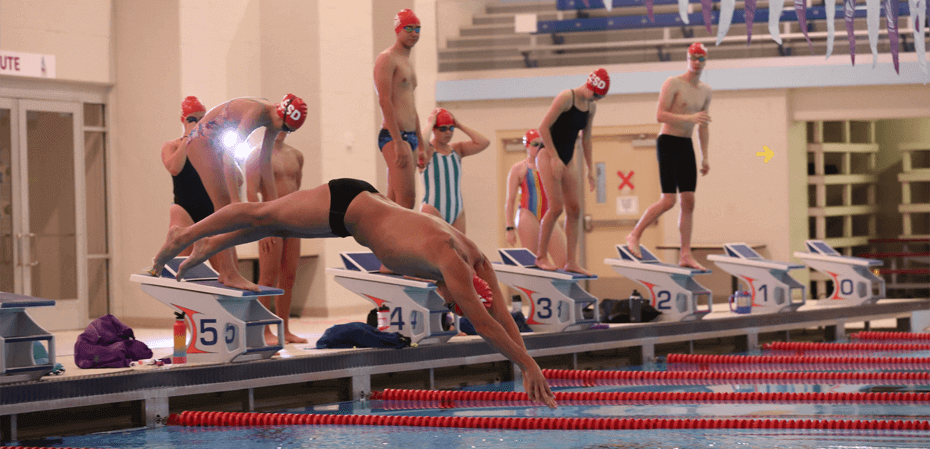
Swimming College Athletic Scholarships for Men
If you’re a high school swimmer who wants to swim at the college level, you probably already know you’ll face stiff competition for both a spot on the roster and scholarship money. We’re here to help. This is a resource for you to use during your college planning and placement process that will help you get noticed, meet deadlines and achieve your goals.
Never forget, in swimming—as in all collegiate sports—you need to take charge of your own recruiting. Narrow down the schools you’d like to attend and compete for. Then, take responsibility for introducing yourself to your sport’s decision-makers at these schools. Keep yourself in front of them in a professional, respectful way with regular emails or phone calls. Work hard to improve your athletic performance while also keeping an eye on your academics.
Earning a spot on any college team—and maybe even being awarded athletic scholarship money—isn’t easy, but don’t despair. While it takes time, discipline and persistence, it is doable.
Men’s Collegiate Swimming – Divisions
As in other college sports, men’s swimming is organized by division under two primary governing bodies: the NCAA and NAIA. Here’s an overview of how these divisions work.
NCAA Division I – Swim Men’s Programs
- There are 143 men’s Division I swim colleges in the U.S. If you dream of being recruited for a DI team, you’re competing against the best swimmers in the country for a spot on the roster. As such, coaches and scouts at these schools can be very picky when it comes to recruiting.
- College sports in general are classified as either head count or equivalency. The main difference between the two in the NCAA is how scholarship money is awarded to athletes. Head count sports have a set number of full-ride scholarships awarded to individual athletes. Equivalency sports have a set amount of scholarship money that coaches divide amongst their roster.
- Since swimming is an equivalency sport, the scholarships are usually divided amongst several student athletes, making it rare for a single student athlete to receive a full-ride scholarship.
Top Division I Swim Programs for Men
Next College Student Athlete (NCSA) offers Power Rankings of the country’s best colleges with men’s swim programs, and are compiled using a number of data sources that factor in various aspects of the college experience, including such things as cost and graduation rates. Use it as a starting point in your search for a college-level swim program you’d like to be accepted into.
- Stanford University
- University of Florida
- Princeton University
- Harvard University
- Yale University
- Columbia University
- University of Pennsylvania, Penn
- University of Michigan
- University of California, Berkeley
- University of North Carolina at Chapel Hill
NCAA Division II – Swim Men’s Programs
- There are 58 Division II men’s swimming programs in the U.S. But just because it’s not DI, don’t be fooled. The level of competition at DII colleges is very high, and coaches recruit using many of the same benchmarks as in DI. Interestingly, though a lot of DII swimmers have the athletic ability to compete at DI, they may have chosen to instead attend a DII school because of other interests or aspirations they have in terms of academics or the overall college experience.
- A fully funded DII team can offer up to nine scholarships, but many teams are not fully funded. As such, coaches frequently divide scholarships between many student athletes.
Top Division II Swim Programs for Men
NCSA offers Power Rankings of the country’s best colleges with men’s swim programs, and are compiled using a number of data sources that factor in various aspects of the college experience, including such things as cost and graduation rates. Use it as a starting point in your search for a college-level swim program you’d like to be accepted into.
- Colorado School of Mines
- West Chester University of Pennsylvania
- Bentley University
- Florida Southern College
- Grand Valley State University
- Rollins College
- Nova Southeastern University
- Truman State University
- Adelphi University
- University of Tampa
NCAA Division III – Swim Men’s Programs
- There are 200 Division III swimming colleges. That’s more than at any other level. Swimmers who want to push themselves academically as well as athletically may find the best fit at a DIII school—able to develop as athletes while still having time and flexibility in their schedules to pursue passions and interests outside of swimming.
- Notably, DIII schools don’t offer athletic scholarships. However, academic-related grants can, and often are, used in lieu of athletic scholarships. Since many DIII swimmers receive financial aid, seeking a DIII roster spot is often a good way to offset the overall cost of college.
Top Division III Swim Programs for Men
NCSA offers Power Rankings of the country’s best colleges with men’s swim programs, and are compiled using a number of data sources that factor in various aspects of the college experience, including such things as cost and graduation rates. Use it as a starting point in your search for a college-level swim program you’d like to be accepted into.
- Massachusetts Institute of Technology (MIT)
- Johns Hopkins University
- University of Chicago
- Emory University
- Tufts University
- Amherst College
- Washington University in St. Louis
- Carnegie Mellon University
- University of Rochester
- Williams College
NAIA – Swim Men’s Programs
- Consisting of generally smaller campuses than the NCAA, the National Association of Intercollegiate Athletics (NAIA) can offer student athletes a more well-rounded college experience than even DIII schools. There are 22 NAIA schools that offer men’s swimming, and fully funded teams can offer up to eight scholarships.
- However, NAIA swim scholarships usually get divided amongst multiple student athletes, making full-ride scholarships rare. That means the amount of scholarship money a swimmer may receive depends on the school, the coach and how they decide to use the overall funds.
Top NAIA Swim Programs for Men
NCSA offers Power Rankings of the country’s best colleges with men’s swim programs, and are compiled using a number of data sources that factor in various aspects of the college experience, including such things as cost and graduation rates. Use it as a starting point in your search for a college-level swim program you’d like to be accepted into.
- Indiana Wesleyan University
- Soka University
- Ave Maria University
- St. Ambrose University
- Olivet Nazarene University
- Loyola University New Orleans
- The College of Idaho
- St. Thomas University, Florida
- University of the Cumberlands
- Arizona Christian University
What Does It Take to Become a Collegiate Swimmer?
For starters, it doesn’t hurt if you have great times, but there are other ways to get the attention of a coach. As an example, how do you respond to adversity? How do you manage stress or pressure? Remember, recruiters are looking at the big picture, the total athlete.
Getting recruited also takes name recognition. In almost all instances, you need to let coaches know you’re interested in getting into their swim programs. Here’s how to do that:
- Take every opportunity to learn from top swim coaches in your area so you can improve your performance. Volunteer at the Y, or mentor a younger student athlete.
- Participate in swim camps. This is a good way to catch the eye of the coaching staff at the college, university, or other organization sponsoring the event. Staff from nearby schools often lend a hand at these events, so they’ll be watching, too. SPIRE Academy swim camps are for those athletes who aspire to attend SPIRE Academy Swim program, which is where college coaches find you!
- Overall, these events are a great way to build connections, improve your physical performance and mental toughness and get an idea of what kinds of coaches and programs you respond to best. Many of these sessions will also create a video of your performance, which will prove invaluable as a way of putting yourself in front of coaches.
- On that note, if you don’t have one already, create a good-quality video that shows you competing and highlights your form.
You may have talent, and you may have self-discipline, but unless you get your name out there in a consistent and respectful way, you may fly under your preferred program’s radar. Show those coaches how much you want to compete for them in their swim program. That type of drive gets attention and will help you distinguish yourself from those you’re competing with.
When Can Colleges Start Recruiting for Men’s Swimming?
- The NCAA dictates when and how college coaches can contact potential recruits.
- For NCAA DI and DII coaches, contact is essentially off-limits until June 15 after the recruit’s sophomore year in high school. College coaches at the DIII and NAIA levels, however, don’t have the same restrictions on when they can reach out to recruits, i.e., they can reach out to anyone they’re interested in at any time.
- On August 1 before junior year, NCAA swimming recruiting rules permit student athletes and their families to take an “official visit.” This means that recruiting efforts really ramp up during junior year. Coaches can send non-recruiting material, like brochures or camp information, at any time. This is also the same time that college coaches can begin communicating with high school and club coaches about their student athletes.
- In creating these rules, the NCAA was trying to make sure elite recruits didn’t get overwhelmed by constant contact from coaches. But the same rules mean it can be tough for swimming families to know when to expect contact from colleges.
Men’s Collegiate Swimming Recruiting Standards
How fast do I need to be? Am I good enough to compete at the college level? If you’re thinking about making the transition from high school swimming to college swimming you’ve probably already asked yourself these questions. The times below, sourced from NCSA, show what swimming coaches at every level of collegiate competition are looking for.
| Event |
Tier 1 Standards (Elite Power 5 D1) |
Tier 2 Standards (Elite D2-D3, Strong Mid-major D1, Power 5 D1) |
Tier 3 Standards (Elite NAIA, Mid-strong D2/D3, Low to Mid-major D1) |
Tier 4 Standards (Low-average D2/D3, Low-strong NAIA) |
| 50 Free |
19.9 and faster |
20.5 – 20.9 |
21.1 – 21.4 |
21.7 – 23.9 |
| 100 Free |
43.8 and faster |
44.9 – 45.4 |
45.9 – 46.5 |
47.8 – 50.9 |
| 200 Free |
1.36.3 and faster |
1.38.5 – 1.39.8 |
1.40.9 – 1.41.8 |
1.43.8 – 1.51.9 |
| 500 Free |
4.23.3 and faster |
4.27.9 – 4.31.5 |
4.35.5 – 4.37.1 |
4.42.8 – 5.09.9 |
| 1650 Free |
15.26.1 and faster |
15.36.9 – 15.46.9 |
15.55.9 – 16.05.0 |
16.24.4 – 17.59.9 |
| 100 Fly |
47.4 and faster |
48.9 – 49.9 |
50.5 – 51.1 |
52.1 – 55.9 |
| 200 Fly |
1.46.7 and faster |
1.49.9 – 1.52.1 |
1.52.9 – 1.53.7 |
1.55.1 – 2.09.9 |
| 100 Back |
47.7 and faster |
49 – 50.8 |
51.5 – 52.1 |
53.4 – 56.9 |
| 200 Back |
1.45.0 and faster |
1.48.5 – 1.50.6 |
1.51.9 – 1.52.8 |
1.54.9 – 2.09.9 |
| 100 Breast |
54.3 and faster |
55.9 – 57.4 |
58.1 – 58.7 |
59.8 – 1.04.9 |
| 200 Breast |
1.58.4 and faster |
2.02.5 – 2.05.7 |
2.07.5 –1.53.5 |
2.09.7 – 2.19.9 |
| 200 IM |
1.46.8 and faster |
1.49.5 – 1.51.5 |
1.53.5 – 1.55.1 |
1.57.1 – 2.09.9 |
| 400 IM |
3.51.5 and faster |
3.55.9 – 4.00.2 |
4.04.9 – 4.07.6 |
4.11.2 – 4.29.9 |
Final Thoughts on Achieving Your Goal
As mentioned earlier, while earning a spot on any college team isn’t easy, with time, discipline and persistence it is doable. Here are some final words of wisdom and strategy on the matter.
- Find The Right Match
By researching schools and targeting programs where your particular skills would add to the team’s ability to put up points, you have a better chance of not just landing a spot on a college roster but even getting some scholarship money. So do your homework and find a program that will benefit from your event strengths. It’s a good way to make yourself stand out to a recruiter.
- Create A Target List
After you’ve done your research, create a list of schools you’re competitive for. There might be a range of programs that span several different levels, and that’s fine. As an example, your event times may put you in the mix for DI recruiting, but if you consider DII or NAIA programs, as well, you might have a better chance of earning a roster spot. Putting it all done on paper (or in a digital document) will help you order your thoughts and see the overall situation more clearly.
- Keep Up Your Grades
Speaking of homework, make sure you keep a focus on your academics as you strive for excellence in your sport. Recruiters will be looking at both. Make sure you’re taking classes as required by the NCAA Eligibility Center, as well as the ACTs and SATs. And if you do land a spot on a college swim team, you’re going to be expected to keep up your academic performance along with your athletic performance, so you might as well get used to doing it now. Good luck!