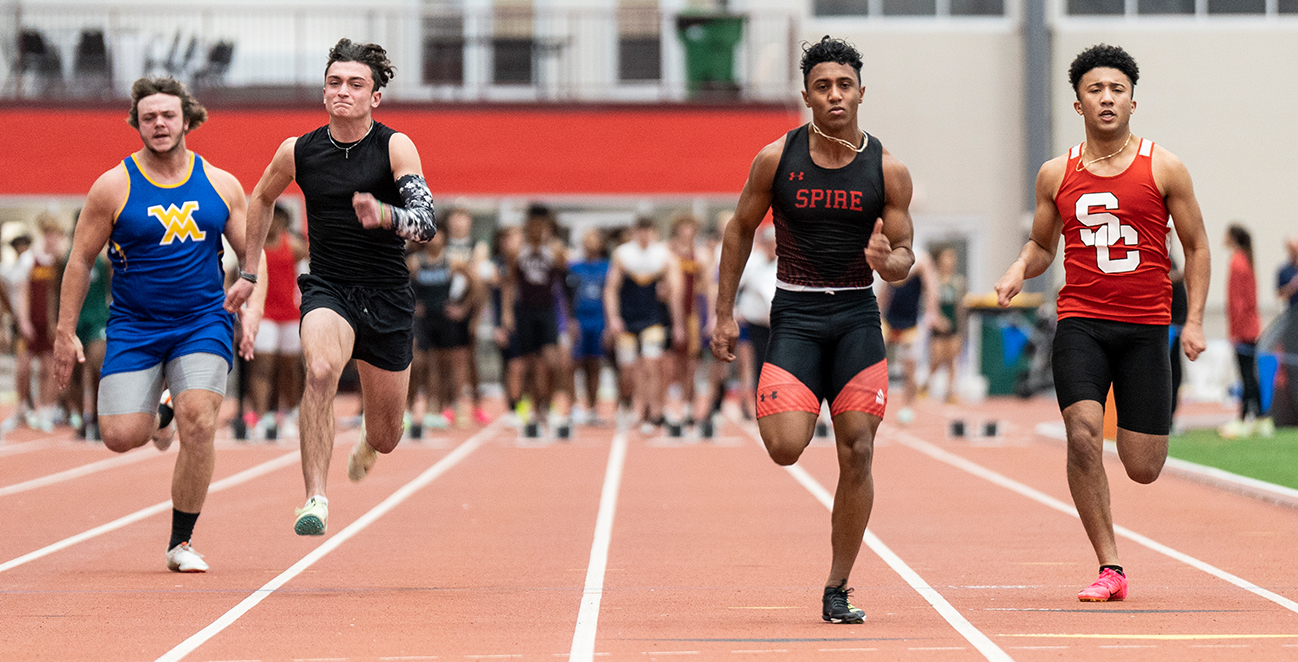
Track & Field College Athletic Scholarships for Men
Track & field is unique in the world of collegiate sports because there’s no “typical” recruiting process. Rules vary based on where you live as well as where the school you want to compete at is located. In addition, every track event is scouted differently. For example, a distance runner will be evaluated on different criteria than a sprinter or hurdler will.
Knowing how to navigate the track-and-field recruiting process may give you an advantage over other student athletes who are not as familiar with its requirements and eccentricities. That’s what this webpage is for–a resource for you to use during your college planning and placement process that will help you learn how to get noticed, meet deadlines and achieve your goal.
Never forget, in track & field—as in all collegiate sports—you need to take charge of your own recruiting. Narrow down the schools you’d like to attend and compete for. Then, take responsibility for introducing yourself to your sport’s decision-makers at these schools. Keep yourself in front of them in a professional, respectful way with regular emails or phone calls. Work hard to improve your athletic performance while also keeping an eye on your academics.
Men’s Collegiate Track & Field—Indoor and Outdoor Divisions
Men’s collegiate Track & Field is divided into indoor and outdoor seasons, each with its own set of events and competition schedules. These programs are organized under different divisions within the NCAA, NAIA, and NJCAA. Here’s an overview of how these divisions work.
NCAA Divisions
Division I
- Indoor Track & Field
The indoor season typically runs from December to March, concluding with the NCAA Indoor Championships. Indoor events include sprints, middle and long-distance races, hurdles, relays, jumps, pole vault, shot put and the heptathlon.
- Outdoor Track & Field
The outdoor season generally starts in late March and runs through June, ending with the NCAA Outdoor Championships. Outdoor events expand to include sprints, middle and long-distance races, hurdles, relays, jumps, pole vault, throws (including javelin, hammer, discus) and the decathlon.
Division II
- Indoor and Outdoor Track & Field
Division II follows a similar structure to Division I, with both indoor and outdoor seasons offering a range of events.
Division III
- Indoor and Outdoor Track & Field
Division III schools also compete in both indoor and outdoor seasons. However, they do not offer athletic scholarships. Instead, financial aid is provided based on academic merit, financial need, and other factors.
NAIA Divisions
- Indoor and Outdoor Track & Field
NAIA programs also feature both indoor and outdoor seasons, with similar events to NCAA’s. The competition level is comparable to NCAA Division II.
Men’s Collegiate Track & Field – By the Numbers
- At any given time, there are more than 600,000 men’s track-and-field high school athletes. As such, it can be difficult for recruits to stand out from the crowd and get attention from college coaches. Only 4.8 percent of that 600,000 will go on to compete at the NCAA level, and only 1.9 percent will compete for a Division I school. Track-and-field programs also recruit internationally. About 9 percent of all international student-athletes at the NCAA DI level compete at a men’s track-and-field college, making up about 0.5 percent of DI rosters.
- These numbers should demonstrate that the high school track-and-field athlete who wants to continue competing at the college level is about to enter a very competitive field of like-minded aspirants. Earning a spot on a collegiate track-and field-roster—and being awarded athletic scholarship money–isn’t easy. It takes time, discipline and persistence, but it’s doable.
What Does It Take to Become an NCAA Track-and-Field Athlete?
For starters, it doesn’t hurt if you have some of the best times in the country, but there are other ways to get the attention of a coach or scout. As an example, how do you respond to adversity? Can you keep your head when you’re behind the field? How do you manage stress or pressure? Remember, recruiters are looking at the big picture, the total athlete.
Getting recruited also takes name recognition. In almost all instances, you need to let coaches know you’re interested in getting into their track-and-field programs.
- Take every opportunity to learn from top track-and-field coaches in your area so you can improve your times and distances. Volunteer at your local Boys and Girls club, or mentor a younger student athlete.
- Participate in track-and-field camps and showcases. This is a good way to catch the eye of the coaching staff at the college, university, or other organization sponsoring the event. Track-and-field staff from nearby schools often lend a hand at these camps and showcases, so they’ll be watching, too.
- Overall, these events are a great way to build connections, improve your physical performance and mental toughness, and get an idea of what kinds of coaches and programs you respond to best. Many of these sessions will also create a video of your performance, which will prove invaluable as a way of putting yourself in front of coaches whose programs interest you.
- On that note, if you don’t have one already, create a good quality video that shows you competing in each of your events that highlights your form, and—if you’re a distance runner—your strategy.
You may have talent and you may have self-discipline, but unless you get your name out there in a consistent and respectful way, you may fly under your preferred program’s radar. Show those coaches how much you want to compete for them in their track-and-field program. That type of drive gets attention and will help you distinguish yourself as one of the fewer than 5.0 percent of high school athletes who go on to a DI, DII or DIII collegiate track-and-field program.
When Can Colleges Start Recruiting for Men’s Track-and-Field Programs?
- The NCAA dictates when and how college coaches can contact potential recruits.
- For NCAA DI and DII coaches, contact is essentially off-limits until June 15 after the recruit’s sophomore year in high school. College coaches at the DIII and NAIA levels, however, don’t have the same restrictions on when they can reach out to recruits, i.e., they can reach out to anyone they’re interested in at any time.
- In creating these rules, the NCAA was trying to make sure elite recruits didn’t get overwhelmed by constant contact from coaches. But the same rules mean it can be tough for track-and-field families to know when to expect contact from college coaches.
Men’s Top Collegiate Track-and-Field Programs
Next College Student Athlete (NCSA) offers power rankings of the country’s best four-year colleges with men’s track-and-field programs. This list includes colleges that offer Track & Field and cross country, only Track & Field and only cross country. Use it as a starting point in your search for a college-level track-and-field program you’d like to be accepted into.
NCAA Division I
- Stanford University
- Princeton University
- University of Florida
- Harvard University
- Columbia University
- Yale University
- University of California, Los Angeles (UCLA)
- University of Pennsylvania
- University of California, Berkeley
- University of Michigan
NCAA Division II
- Colorado School of Mines
- Hillsdale College
- West Chester University of Pennsylvania
- Bentley University
- Florida Southern College
- Grand Valley State University
- California State Polytechnic University, Pomona
- Truman State University
- Nova Southeastern University
- Adelphi University
NCAA Division III
- Massachusetts Institute of Technology (MIT)
- Johns Hopkins University
- University of Chicago
- Emory University
- Tufts University
- Amherst College
- Washington University in St. Louis
- Carnegie Mellon University
- Williams College
- University of Rochester
NAIA
- Dordt University
- Indiana Wesleyan University
- University of California, Merced
- Soka University
- Oklahoma City University
- University of Michigan, Dearborn
- Marian University, Indiana
- Madonna University
- Southeastern University
- Northwest College, Iowa
- Men’s Collegiate Track-and-Field Scholarships
Men’s track-and-field scholarships are available at the NCAA Division I and Division II levels as well as NAIA schools. These scholarships can cover a range of expenses, including tuition, room and board, books and sometimes additional fees related to attending college.
Understanding the process of everything it takes to secure these scholarships is crucial. Here’s an overview.
NCAA Divisions and Scholarship Limits
Division I
- Track & Field/Cross Country
Men’s programs are considered equivalency sports, meaning coaches can divide the total number of scholarships among several athletes.
- Scholarship Limit
Men’s track-and-field programs in Division I can offer up to 12.6 full scholarships per team. These scholarships can be split among multiple athletes.
Division II
- Track & Field/Cross Country
Similar to Division I, these programs are also equivalency sports.
- Scholarship Limit
Men’s programs in Division II can offer up to 12.6 full scholarships per team, which can also be divided among athletes.
Division III
- Division III schools don’t offer athletic scholarships, but they may provide other forms of financial aid based on academics, leadership or other factors.
NAIA Divisions and Scholarship Limits
- NAIA offers scholarships, with member schools providing up to 12 track-and-field scholarships for men’s programs. These are also equivalency scholarships.
How Track & Field Scholarships Are Awarded
- Full Scholarships
Cover tuition, fees, room, board and course-related books. However, full scholarships are rare, especially in equivalency sports like Track & Field.
- Partial Scholarships
Coaches often split scholarships among multiple athletes. For example, one athlete might receive 50 percent of a scholarship, while another might get 25 percent.
- Walk-Ons
Athletes who are not on scholarship can still compete as walk-ons, and some may earn scholarships in later years.
Additional Considerations
- Performance
Scholarship awards are generally based on the athlete’s performance in high school or junior college, including their times, distances and overall athletic potential.
- Academics
Academic achievement can also influence scholarship opportunities, especially in Division III and NAIA schools.
- Recruitment
The recruitment process for track-and-field athletes often involves showcases, camps and direct communication with college coaches.
Men’s track-and-field scholarships are highly competitive, and securing one requires a combination of athletic talent, academic achievement, and strategic planning throughout high school.
Athletes interested in such scholarships should start the recruitment process early, maintain strong academic performance and actively reach out to coaches to express interest and share their athletic achievements.
Men’s Collegiate Track-and-Field Recruiting Standards
Division I
Top Performance Expectations
Division I programs have the highest recruiting standards, requiring athletes to perform at an elite level in high school.
Event-Specific Standards (approximate)
- 100m Sprint: < 10.5 seconds
- 200m Sprint: < 21.2 seconds
- 400m Sprint: < 47.5 seconds
- 800m Run: < 1:52.0 minutes
- 1600m Run: < 4:10.0 minutes
- 110m Hurdles: < 14.0 seconds
- Long Jump: > 7.20 meters (23’7″)
- High Jump: > 2.05 meters (6’9″)
- Shot Put: > 17.50 meters (57’5″)
- Discus Throw: > 55.00 meters (180’5″)
Division II
Strong but Slightly Lower Standards
Division II programs are competitive but generally have slightly lower performance requirements than Division I.
Event-Specific Standards (approximate)
- 100m Sprint: ~10.7-11.0 seconds
- 200m Sprint: ~21.5-22.0 seconds
- 400m Sprint: ~48.5-50.0 seconds
- 800m Run: ~1:54.0-1:58.0 minutes
- 1600m Run: ~4:15.0-4:25.0 minutes
- 110m Hurdles: ~14.3-14.8 seconds
- Long Jump: ~6.90-7.10 meters (22’7″-23’3″)
- High Jump: ~1.95-2.05 meters (6’5″-6’9″)
- Shot Put: ~16.00-17.00 meters (52’6″-55’9″)
- Discus Throw: ~50.00-52.00 meters (164’0″-170’7″)
Division III
Varied Standards
While Division III schools don’t offer athletic scholarships, the competition remains strong. Standards can vary significantly depending on the institution.
Event-Specific Standards (approximate)
- 100m Sprint: ~11.0-11.4 seconds
- 200m Sprint: ~22.5-23.5 seconds
- 400m Sprint: ~50.0-52.0 seconds
- 800m Run: ~1:58.0-2:05.0 minutes
- 1600m Run: ~4:25.0-4:40.0 minutes
- 110m Hurdles: ~15.0-15.8 seconds
- Long Jump: ~6.50-7.00 meters (21’4″-23’0″)
- High Jump: ~1.85-1.95 meters (6’1″-6’5″)
- Shot Put: ~14.00-15.50 meters (45’11”-50’10”)
- Discus Throw: ~45.00-48.00 meters (147’8″-157’6″)
NAIA
Comparable to NCAA Division II
NAIA programs often have standards similar to those of NCAA Division II, though they can vary widely depending on the specific school and program. Event-Specific Standards generally fall between those of Division II and Division III.
Additional considerations
- Versatility
Coaches highly value athletes who can perform well in multiple events, as this versatility can be critical to a team’s overall success.
- Academic Performance
Strong academic records are essential, particularly for Division III schools, where academic scholarships are more common.
- Potential and Progression
Coaches look for athletes who have shown steady improvement throughout high school and who have the potential to develop further in college.
- Recruiting Process
The recruiting process often begins in the junior year of high school, with athletes reaching out to coaches, attending showcases, and competing in top-tier events to attract attention.
Meeting or exceeding all these standards significantly increases the likelihood of being recruited, though coaches also consider other factors like work ethic, team fit, and the athlete’s potential for growth.
How Do Men’s Collegiate Track-and-Field Coaches Decide Who Gets a Scholarship?
Coaches tend to give athletic scholarships based on a recruit’s performance in individual or multiple events. Typically, they prioritize scholarships for recruits who can make an impact right away and put big scores on the board at meets.
Consider targeting divisions and programs where your scores not only meet the standards but really stand out. You may be able to meet the standards of a DI school, but you may earn more scholarship money at the DII levels, where you can potentially make a bigger impact.
Try to get to know the coaches who run the programs at your schools of choice so you can understand what their recruiting needs are. This will help you position yourself in the best way possible to fill a gap on the team roster.
- Jumpers with proven records of good marks who can score points immediately will catch a coach’s eye, but solid performers who show room for improvement and a motivation to participate in year-round training are also invaluable.
- Throwers who are athletic and strong are valuable additions to any track-and-field team. Willingness to try specialty events like hammer and javelin, that were perhaps not as popular at the high school level, is also a plus. Keep in mind that college weights are heavier than in high school, so coaches are always particularly on the lookout for strong discus or shot throwers.
- Sprinters who show an ability to compete and score across multiple events are moved to the top of the list of potential recruits. As long as the sprinter is fast, most coaches will work with them on technique and form.
- Middle-distance runners who have outstanding speed, solid biomechanics, and a willingness to try different events such as cross country at the college level get noticed.
- Distance runners are recruited based on how well their running style fits within the college’s training program.